The future of work with AI: what jobs actually look like
If you spend any time on Reddit or X, you'd think the end of employment is basically around the corner. The headlines say AI will replace everyone, and the CEOs of some of the biggest AI companies have made similar statements in public. As someone who is a software developer by trade, I've spent the last three years hearing that my job is essentially finished.
I'm busier than ever.
Understanding why tells you a lot about the future of work with AI and how it's actually likely to play out.
What software development shows us
Developers have been living with AI coding tools longer than most industries. GitHub Copilot launched, then OpenAI's Codex and Anthropic's Claude Code. If AI was going to hollow out a profession fast, software development would have been first in line.
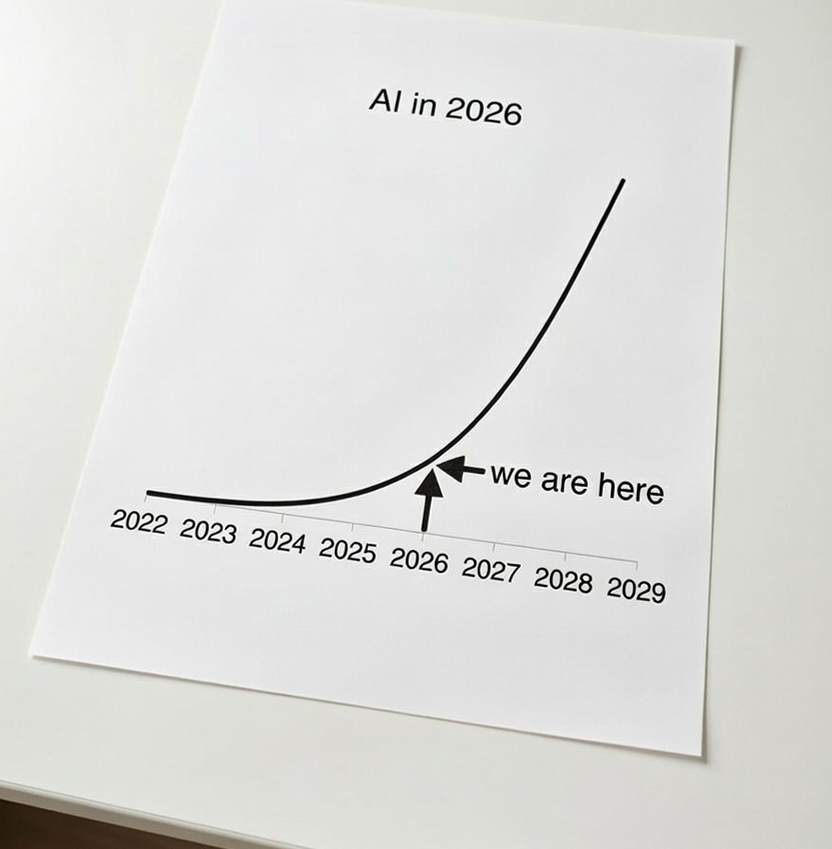
With the right AI tools, a developer today can genuinely get about ten times more done in a single day than they could a few years ago without them. The productivity jump is real and it's significant.
But something very interesting is that demand has grown at the same pace.
The backlog of things people want built has expanded at roughly the same pace as the productivity gains. Companies that previously couldn't afford to build software have started building it. And, companies have started replacing expensive off the shelf organizational tools with custom in-house solutions. At least for now, there is real demand for all that extra output, and AI still needs a human in the loop to get it right.
This is the pattern we expect to see repeat itself across many industries.
What happens when agents reach your field
General AI agents like Claude Cowork are beginning to do for other professionals what AI coding tools did for developers. These aren't just chatbots that answer questions. They can manage email and calendars, conduct research, synthesize findings, produce formatted documents, and work through multi-step tasks with minimal oversight.
Consider a sales rep. A big chunk of their week goes to prospecting, writing follow-up emails, updating the CRM, preparing for calls, and logging activity after them. An AI agent can take over large portions of that workflow. Not perfectly, and not without the rep's judgment and relationships, but well enough to free up serious time for the high-value interactions that actually close deals.
The same story plays out in marketing, HR, accounting, and basically any knowledge-work role. The lower-skill, higher-volume parts of these jobs are the most susceptible to being handled by AI. The parts that require real judgment, experience, and human connection are much harder to automate, and they tend to be the parts that matter most anyway.
Jobs are changing, but not disappearing. And the professionals who adapt fastest will have a real advantage.
The quote we believe in
There's a line from Jensen Huang, the CEO of Nvidia, that we display on our home page because we think it's worth repeating:
"You're not going to lose your job to AI, but to somebody who uses AI."
It's a useful framing. The risk isn't really the technology itself. The risk is ignoring the technology while the person in the next office figures it out.
When spreadsheets first arrived, accountants who learned Excel didn't get replaced by the software. They became significantly more productive than the ones who stuck to doing everything by hand, and they were the ones advancing in their careers. The exact same dynamic is playing out right now, across almost every field, just at a larger scale and faster.
Learn how to apply this technology to your specific work. The people who do that will routinely accomplish in one day what used to take two or three. That is a real competitive advantage, and it's sitting there for anyone willing to pick it up.
Why jobs won't just disappear overnight
The "AI will replace everyone" story is very loud right now. It's worth asking who benefits from telling it.
Large AI companies are raising staggering amounts of capital to continue building out their systems. To justify those valuations and attract that investment, they need to sell a vision that sounds as transformative as possible. Saying their technology will "replace human labour" at scale makes for an excellent investor pitch and generates enormous media coverage. Neither of those incentives has much to do with making an accurate prediction about what's going to happen to employment.
The more realistic picture is that AI is genuinely powerful and will genuinely change how work gets done. Some specific job categories will shrink over time. But the idea that jobs broadly just evaporate in a few years doesn't hold up when you look at how similar disruptions have played out. New tools create new categories of work. The adjustment is real, but it's not the cliff edge the headlines imply.
Corporate incentives versus small business opportunity
It's worth noting a structural shift that doesn't get nearly enough attention. Large public companies and small businesses respond to AI very differently, and the effects are pushing in opposite directions.
Large public companies are rewarded by financial markets for cutting costs. Reducing headcount improves their bottom line in ways that show up clearly in quarterly earnings. When AI can reliably handle work that used to require multiple employees, the incentive for a big company is straightforward: slow hiring and eventually reduce the workforce over time. This is already happening in some sectors.
Small businesses face a different situation. Most are in some stage of growth and are not looking to cut people. Instead, they're looking to punch above their weight class and attract more clients. A five-person marketing agency that uses AI well can produce work that previously required fifteen people. A small accounting firm can take on more clients without hiring proportionally. The math looks completely different.
What follows from this is that large organizations will likely continue to slow hiring, while many more small companies will pop up and succeed with lean teams. Picture a company doing real, profitable work with five people. That would have been unusual a decade ago. In the next few years, it is likely to be increasingly common.
Organizations are likely to become flatter and smaller, but there will be more of them. The total number of jobs may not shrink nearly as fast as the pessimists predict, because the new opportunities will emerge in smaller, faster-moving companies rather than inside large corporations.
Going deeper on this topic
If the future of work with AI is something you want to understand more deeply, one book stands out: Co-Intelligence: Living and Working with AI by Ethan Mollick, published in 2024. Mollick is a professor at the Wharton School who has spent years studying AI in practical, real-world contexts. The book reads more like a conversation than a lecture, and it's particularly good on the question of how individuals can adapt and actually benefit from the shift rather than just survive it.
The future of work is not something that simply happens to you. Start learning how to apply AI to your specific role today, pay attention to how your field is changing, and don't get complacent. That's the best practical advice available right now, and it applies regardless of what industry you're in.